TattoosLuv
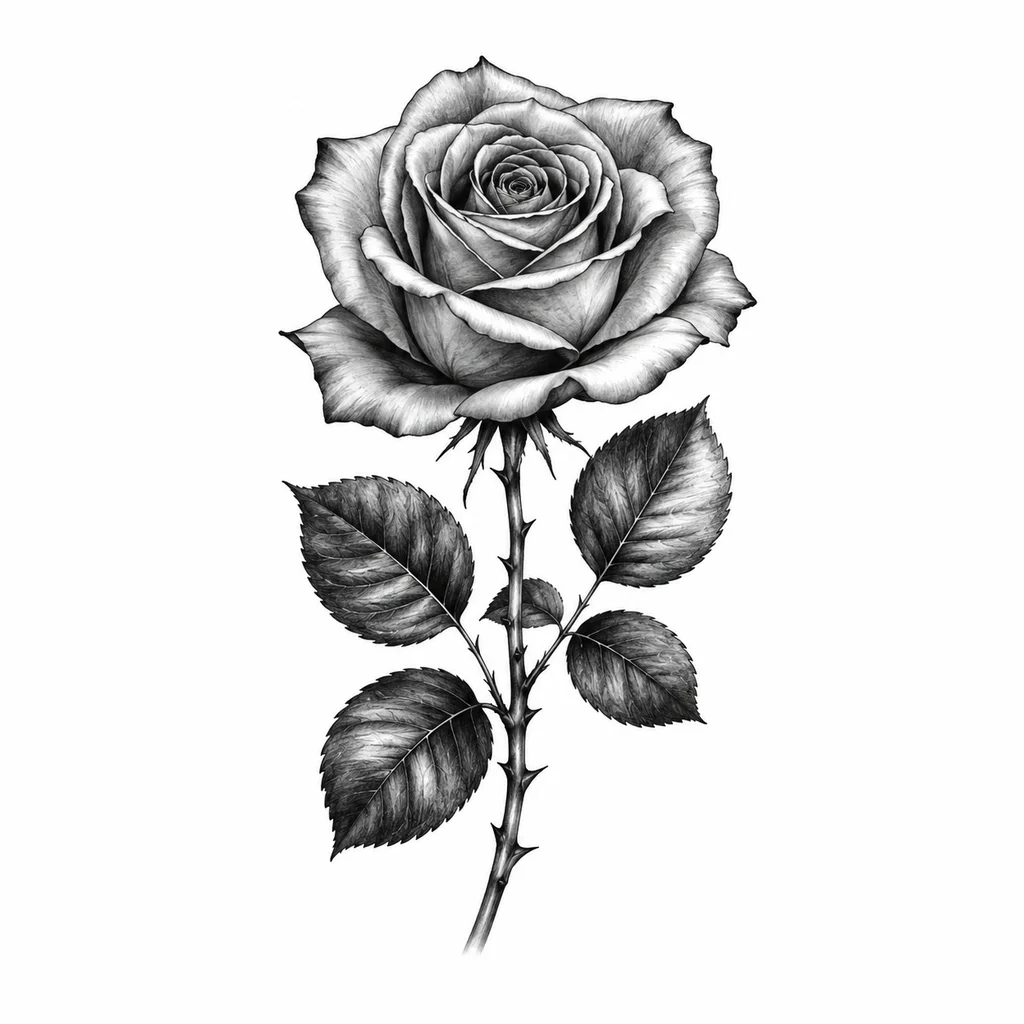
Realistic rose tattoo representing love, beauty, and passion

Rose Tattoo Meaning & Symbolism

Rose tattoos symbolize love, beauty, and transformation. Color carries most of the meaning: red for passion, white for purity, black for grief, yellow for friendship, pink for first love.

## Symbolism The rose is one of the oldest and most loaded symbols in tattoo culture. At its core, the rose represents love and beauty — but the specific meaning depends almost entirely on color, context, and accompanying elements like thorns, stems, leaves, or daggers. A rose with a stem and thorns says something different from a single perfect bloom. A rose paired with a name or date is usually a memorial. A black rose carries weight that a red rose doesn't. A bouquet of roses says one thing; a single rose says another. Underlying every rose tattoo is the same paradox the flower itself embodies: beauty inseparable from pain. The thorn doesn't ruin the rose — it's part of why we recognize it. ## History & Cultural Meaning The rose's symbolic depth comes from thousands of years of cultural meaning across traditions. **Greek and Roman mythology** linked the rose to Aphrodite/Venus, the goddess of love. The flower was said to have first bloomed white, then turned red when stained by the blood of Adonis or by Aphrodite's own tears. **Christian symbolism** uses the white rose for the purity of the Virgin Mary and the red rose for Christ's blood and martyrdom. The five petals of the wild rose are sometimes read as the five wounds of Christ. **English Tudor history** gave us the Tudor Rose — red and white combined — symbolizing the union of the houses of Lancaster and York after the Wars of the Roses. The image lives on in heraldry and traditional flash sheets. **American sailor tradition** brought the rose into mainstream tattoo culture. A single red rose with a name was the classic memorial or sweetheart tattoo, painted across the arm of returning sailors. The bold-line, saturated-color American traditional rose still defines what most people picture when they hear "rose tattoo." **Modern symbolism** has expanded the rose into nearly every direction — feminine power, queer identity (especially the pink and rainbow rose), addiction recovery (the rose blooming through a chain or thorns), grief and remembrance (the black or wilted rose), and self-love. ## Color Meanings The color of your rose tattoo carries most of its meaning: - **Red** — love, passion, romance, courage. The default for memorial and sweetheart tattoos. - **Black** — grief, loss, rebellion, mystery, end of a chapter. Often chosen for memorial work or as a statement of resilience. - **White** — purity, innocence, remembrance, new beginnings. Common in religious and memorial contexts. - **Yellow** — friendship, joy, warmth. Less common as a sole tattoo color but powerful in mixed bouquets. - **Pink** — first love, gratitude, grace, gentleness. Often chosen for tattoos honoring mothers or daughters. - **Blue** (uncommon, dyed) — mystery, the unattainable, longing. - **Black and grey realistic** — most popular contemporary style; reads as timeless rather than tied to one specific meaning. ## Style Variations Rose tattoos work in nearly every style, which is part of why they remain endlessly popular. - **American traditional** — bold black outlines, saturated red and green. Sailor flash heritage. Best on arm, chest, forearm. - **Neo-traditional** — traditional structure with more shading, color depth, and modern composition. Best on thigh, arm, calf. - **Realistic / photorealistic** — black and grey or full color, photographic detail. Best on forearm, shoulder, chest, back. - **Fine line** — delicate thin black linework, minimal shading. Best on wrist, forearm, ribs. - **Watercolor** — soft pink and red washes, paint splash effects. Best on shoulder, back, thigh. - **Blackwork** — solid filled silhouettes, dramatic and bold. Best on arm, chest, back. - **Dotwork** — built from stippled dots rather than continuous lines. Soft and contemplative. - **Minimalist** — single-line or simple outline, suitable for tiny placements. ## Placement Guide Rose placement is largely about size and visibility tradeoffs: - **Forearm** (most popular) — inner forearm for intimate viewing, outer forearm for daily display. Suits all styles. - **Shoulder** (medium-large) — perfect for realistic and watercolor pieces. - **Chest** (large, statement) — for centerpiece designs, memorials, and traditional sailor-style pieces. - **Back** (large, hidden) — best for cascading rose compositions and large realistic pieces. - **Wrist** (small, visible) — fine-line and minimalist styles only. - **Ankle** (small, mostly hidden) — quiet placement that peeks out with sandals. - **Finger** (tiny, visible) — bold daily wear, but tends to fade faster than other placements. - **Thigh** (medium-large, mostly hidden) — great for neo-traditional and watercolor work. - **Behind ear / collarbone** (small, intimate) — for delicate fine-line pieces. Pain levels: outer arm, outer forearm, outer thigh, and shoulder cap are the lowest pain. Wrist, ankle, and chest are moderate. Ribs, sternum, hip, and inner forearm closer to the wrist are higher pain. ## Choosing Your Design Before you book, work through these questions: - **What does it mean for you?** Love, grief, recovery, memory of someone, self-acceptance — your answer should drive everything else, including style and color. - **Color or black-and-grey?** Color tells the meaning more directly (red for love, black for grief) but needs more touch-ups. Black-and-grey ages slower and reads as timeless. - **Single rose or composition?** A single rose is intimate and personal. A bouquet or cascading composition reads as more elaborate, often used for memorials covering multiple people or major life transitions. - **With or without thorns?** Thorns add weight — they say "beauty includes pain" or "hard-won." Without thorns, the rose reads as softer and more decorative. - **Pair with text?** A name, date, or short phrase changes the rose into a memorial or commitment piece. Make sure you're certain about the wording. When in doubt, start with a single rose on the forearm or shoulder. It's the canonical placement, suits any style, and leaves room to add to the composition over time.

Frequently Asked Questions

What does a rose tattoo really mean?

Rose tattoos symbolize love and beauty at their core, but the specific meaning depends on color: red for passion and love, white for purity and remembrance, black for grief or rebellion, yellow for friendship, pink for first love or grace. A rose with thorns adds the weight of 'beauty inseparable from pain'; a rose paired with a name or date is usually a memorial.

Is a rose tattoo masculine or feminine?

Roses are one of the most gender-neutral tattoo subjects. Traditional American sailor-style roses with bold red color have always been popular with men. Bold blackwork and realistic black-and-grey roses are widely chosen by men, while delicate fine-line and watercolor roses are more often chosen by women — but none of these are exclusive.

What does a black rose tattoo mean?

Black rose tattoos most commonly symbolize grief, loss, the end of a chapter, or rebellion. They're frequently chosen for memorial work — honoring someone who has died — or as a statement of resilience after a difficult period. In some subcultures the black rose also represents mystery, anarchy, or counterculture identity. Less commonly it represents an unattainable love or farewell.

Where on the body do rose tattoos look best?

The forearm is the most popular and versatile placement — visible, easy to show off, and with enough canvas for any style. Other strong placements: shoulder (for realistic and watercolor), chest (for large statement pieces), back (for cascading compositions), wrist (for fine-line and minimalist), and ankle (for small designs). Avoid the top of feet, hands, or fingers if you want color to last.

Do rose tattoos hurt a lot?

Pain depends mostly on placement, not the design. Outer forearm, outer arm, outer thigh, and shoulder cap are low to moderate pain. Wrist, ankle, and outer chest are moderate. Inner forearm closer to the wrist, ribs, sternum, hip, and the back of the neck are higher pain. A medium-sized forearm rose typically takes 1-3 hours of tattooing time.

How long do rose tattoos last?

Black-and-grey rose tattoos in fine-line or realistic styles last very well — typically 10+ years before needing any touch-up if cared for properly. Color roses (especially red and watercolor) tend to fade faster and may need touch-ups every 5-7 years to stay vibrant. Sun exposure is the biggest factor: use SPF on any visible tattoo you want to keep crisp.